
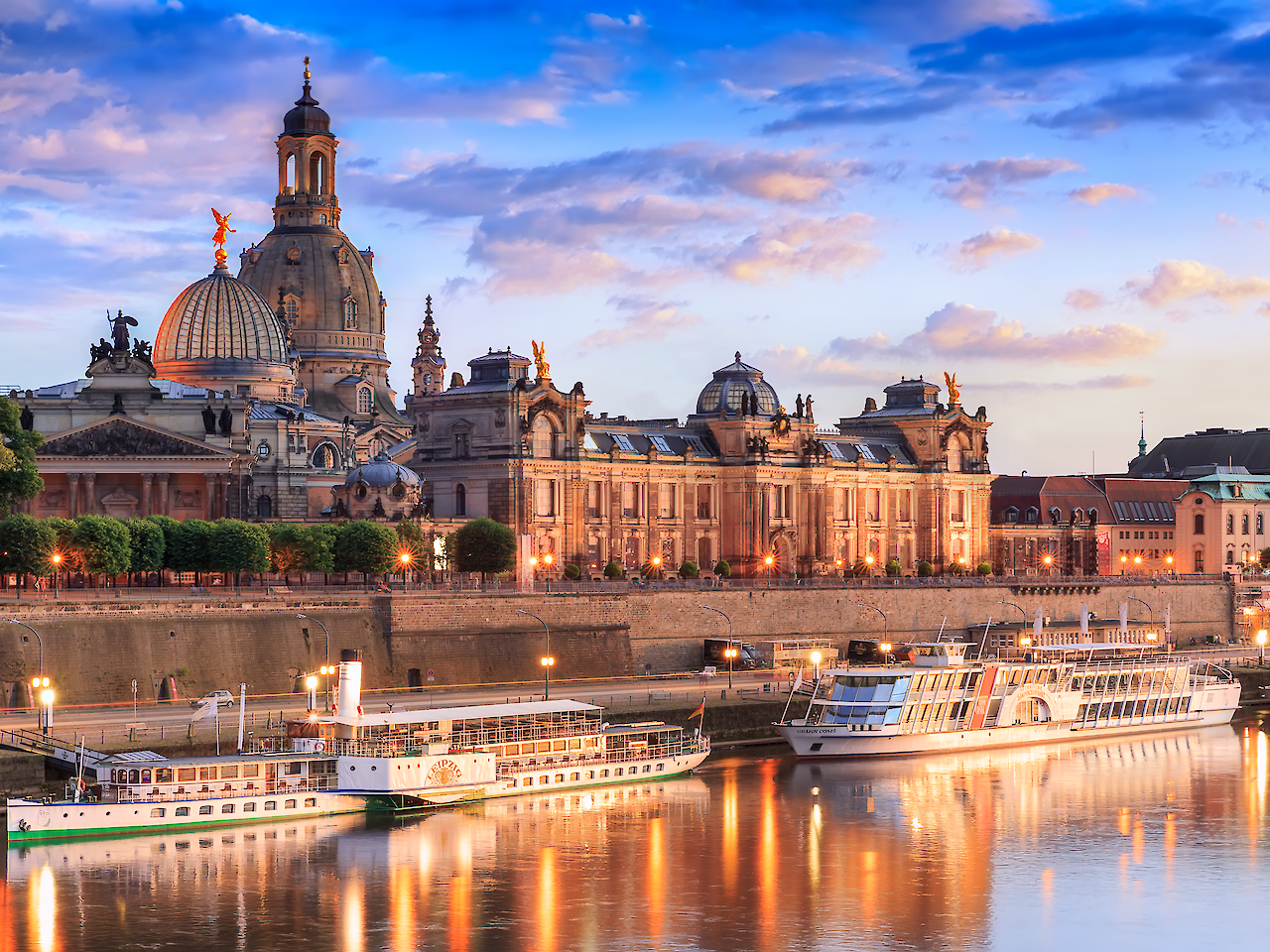
Tour of Dresden's Old Town
The Baroque Old Town is the heart of Dresden, which is why we have put together a short tour of the Old Town. Below you will also find a map to help you find your way around.
To get to the Old Town you can either:
- walk (approx. 30 min)
- or you can walk to the Louisenstraße stop and take the Tram 7 to Theaterplatz (approx. 10 min on foot and 7 min by tram)
- or you can first take a look at the Neustadt and walk this tour
There are many museums in the old town, which are only mentioned here - more information about the museums can be found here.
We start at the Theaterplatz. On the square stands the King John Monument, which was installed in 1899 to mark the 800th anniversary of the House of Wettin, which ruled Saxony at the time. The Semperoper opera house is also located on Theaterplatz.
The Semperoper
The Semperoper is one of Germany's most famous opera houses. It was named after its architect, Gottfried Semper, and is considered an outstanding example of Neo-Renaissance architecture. The building was originally completed in 1841, but burned down in 1869 and was subsequently reopened in 1878. In February 1945, the opera house was destroyed again. The current building was not reopened until 1985!
The Semperoper is not only known for its impressive architecture, but also for its first-class performances. It is home to the Saxon State Opera and offers a diverse repertoire ranging from classical operas and ballet to modern productions. Numerous famous artists and conductors have performed here, and the opera attracts thousands of visitors every year.
The building is characterized by its monumental facade, which is decorated with ornate reliefs and sculptures. Particularly striking are the four allegorical figures representing music, poetry, drama, and music. Above the entrance is the Quadriga. It shows a chariot drawn by four horses and driven by Victoria, the goddess of victory.
The Semperoper is not only beautiful from the outside, but it is also worth taking a look inside. You'll need to book a guided tour, which you can do here.
If we turn left on Theaterplatz, we come to the Zwinger.
Zwinger (Zwinger Palace)
The Zwinger is one of Germany's most impressive Baroque buildings. Augustus the Strong commissioned the complex after visiting Louis XIV's Palace of Versailles. The palace was designed as an orangery, garden, and festival venue. Architect Matthäus Daniel Pöppelmann designed the palace, which was built between 1710 and 1728.
The name Zwinger refers to an area between the defensive walls. In the 15th century, there was a Zwinger garden between the city walls in Dresden, which supplied the royal court with fresh products. Today's Zwinger is located in a different place, but the entire complex has retained the name of the old garden. The Zwinger was primarily a royal pleasure garden and is characterized by richly decorated portals and extravagant fountains. It is worth making your way to the western pavilion, where you will find the Nymph Bath by sculptor Balthasar Permoser—a beautiful example of the Zwinger's fabulous Baroque fountains.
Other attractions include an Atlas sculpture, also located on the western pavilion, known as the Wall Pavilion. In addition, there is a carillon with 40 porcelain bells in the eastern carillon pavilion. The bells ring every quarter hour, slightly longer on the hour, and at 10.15 a.m., 2.15 p.m., and 6.15 p.m., a bell symphony sounds for about 5 minutes. The carillon plays melodies by Vivaldi, Mozart, Bach, Wagner, and Weber.
The courtyard garden and pond were added in the 1820s. The gallery wing, which now houses the Old Masters Picture Gallery, was built in 1855.
The Zwinger was severely damaged during the bombing raids of World War II. It was reconstructed and rebuilt in the 1950s. The Zwinger houses three museums, including the Old Masters Picture Gallery, the Porcelain Collection, and the Collection of Mathematical and Physical Instruments.
The gardens are open to the public free of charge.
If you walk through the Glockenspielpavillon, you will see the Residenzschloss on the other side of the street, to the left.
Residenzschloss (Residential Palace)
Dresden Castle is one of the oldest buildings in Dresden. It served as a royal residence for almost 400 years and was the castle of the Saxon electors. The castle features various architectural styles, such as Baroque and Neo-Renaissance. It was originally built in the 13th century as a Romanesque keep. The keep was expanded in the 15th century and again in the 16th century. The castle was damaged in a fire in 1701, and Augustus the Strong rebuilt it and added the collection rooms in the west wing. The palace was rebuilt in the Baroque style.
The House of Wettin celebrated its 800th anniversary with further renovations and extensions between 1889 and 1901. The stable courtyard was painted with the famous “Fürstenzug” (Procession of Princes). In 1914, the palace was modernized with heating and electric lighting.
The bombs of World War II severely damaged Dresden Castle. Restoration work began in the 1960s and continues to this day.
Today, the palace houses a collection of museums located in the collection rooms of Augustus the Strong. The museums include the Historic Green Vault, the New Green Vault, the Numismatic Cabinet, the Graphic Collection, and the Dresden Armory. Guests can also visit an art library with 260,000 titles on art history. The castle's tower, the Hausmannsturm, is one of Dresden's most striking buildings at 100.27 meters high. It can be climbed and is a popular vantage point.
Another highlight is the English Staircase, the main staircase of Dresden Palace. The walls and ceilings of the staircase have been restored to their neo-baroque style from 1895.
We now walk along Sporergasse towards Neumarkt. At Neumarkt, you will find the Transport Museum, a wide variety of cafes and restaurants, and, above all, one of Dresden's most famous landmarks: the Frauenkirche.
Frauenkirche (Church of our Lady)
The first Frauenkirche was a Catholic church built in the 11th century. During the Reformation, it became a Protestant church. The original church was demolished and replaced by the new Lutheran church.
In 1736, Gottfried Silbermann built an extraordinary organ with 43 registers for the church. Johann Sebastian Bach played a concert on this organ on December 1, 1736. The church's iconic dome is 96 meters high. The dome is also known as the “Stone Bell.” The dome is often compared to Michelangelo's dome of St. Peter's Basilica. The Stone Bell weighed 12,000 tons and was originally supported by eight pillars. In 1945, Dresden was bombed by Allied forces. The church survived two days of attacks before collapsing. While most of the church was destroyed, the original altar and sanctuary were saved.
The residents saved and numbered the stone fragments in the hope of being able to use them in a later reconstruction. In 1994, Gunter Blobel received the Nobel Prize for Medicine and donated his prize money to the restoration of the Frauenkirche. In addition, Prince Edward of England supported the Dresden Trust, which provided funds for the reconstruction project. The reconstruction of the Frauenkirche cost 180 million euros. Reconstruction work began in 1992 and was completed in 2005. The church was rebuilt using the original plans from the 1720s and salvaged materials. Approximately 3,800 original stones were used in the reconstruction. The original stones can be seen in the building, as they are significantly darker due to their age and fire damage. The reconstruction of the church was a collaborative effort. The construction workers relied on photographs and memories to reconstruct the details. For example, old wedding albums helped to reconstruct the carved oak doors of the church. A new imperial orb and cross were forged and placed on top of the dome. The damaged original cross stands inside the church next to the altar. The original organ was replaced by an organ with 68 stops.
Now we walk along Töpferstraße and arrive at the Fürstenzug (Procession of Princes).
Fürstenzug (The Procession of Princes)
The Fürstenzug is an impressive mural depicting the rulers of Saxony. The painting was commissioned in 1889 to mark the 800th anniversary of the Wettin dynasty. Wilhelm Walther painted the original painting. It took Walther five years to complete the painting, which was finished in 1876.
When the artwork began to fade, a conservation plan was implemented. Between 1904 and 1907, the painting was replaced with 23,000 porcelain tiles to make the artwork weatherproof. The Fürstenzug is 102 meters long, making it the largest porcelain artwork in the world. The mural depicts the portraits of the 35 margraves, electors, dukes, and kings of the House of Wettin from 1127 to 1904. The rulers are depicted on horses, with their names written beneath them. The first ruler on the procession wall is Konrad, Margrave of Meissen, from the 12th century. The last king of Saxony, Friedrich August III, who reigned from 1904 to 1918, is not depicted. The mural also shows 59 farmers, craftsmen, scientists, artists, and children. A girl in the group of children is the only woman in the procession. The last person in the procession is the original creator of the mural, Wilhelm Walther.
The Fürstenzug was designed like a giant tapestry. At the top edge, there are 38 individual buttons that make the mural look like a tapestry hanging on the wall. The mural also features an ornamental frame with plants, butterflies, and birds.
At the end of the Fürstenzug, you will reach the Schlossplatz (Palace Square).
The Schloßplatz (Palace Square or Castle Square)
Schlossplatz is a city square in the center of Dresden. It takes its name from Dresden Castle, the royal residence of the electors and kings of Saxony, which is located on the south side of the square. The square dates back to the 15th century and was destroyed during the bombing of Dresden in World War II. In recent years, the buildings surrounding the square have been extensively restored, giving the square back its historic character.
From Schlossplatz, a large staircase (impossible to miss) leads up to the Brühl's Terraces.
Brühlsche Terrassen (Brühl's Terraces)
The Brühlsche Terrassen are often referred to as the “Balcony of Europe.” This elevated terrace overlooking the Elbe River is a popular place to stroll, admire the architecture, and enjoy a street café.
The Brühlsche Terrasse was built on the city's fortifications, which were rebuilt in 1547. The terrace is named after Count Heinrich von Brühl, who owned a city palace in Dresden. In 1747, the Saxon Elector Brühl donated the terrace as a token of gratitude for the introduction of a recovery tax.
When Russian troops occupied Dresden in 1814, Prince Nikolai Grigorievich Repnin-Volkonsky ordered the terrace to be opened to the public. At that time, architect Gottlob Friedrich Thormeyer built a staircase at the western end of the terrace, which was accessible from Schlossplatz and Augustusbrücke. The original buildings on the terrace were destroyed during the bombing raids of World War II. Since then, the terrace has been rebuilt and is one of Dresden's main attractions. On the terrace stands a monument to Johann Friedrich Böttger, an alchemist who invented European porcelain. Near the monument, a fingerprint can be seen on one of the garden railings. This fingerprint is said to have been left by the legendary Augustus the Strong.
Today's terrace buildings include the Saxon Supreme Court, the Saxon House of Representatives, the Academy of Fine Arts, and the Albertinum. As you stroll across the terrace, you can discover many artists painting and selling their works of art.
-
perfect location: in the middle of life in the trendy district
-
Delicious healthy breakfast buffet, plentiful and reasonably priced
-
fully equipped guest kitchen for low-cost self-catering
-
Rooms with private shower or affordable shared rooms
-
you can get all information about events and nightlife directly from us
-
24h reception - checking in at night is no problem
-
Own bar in the house - open around the clock
-
Free tea and coffee all day long
-
fast reliable W-LAN and computer for guests
-
Cosy lounge